

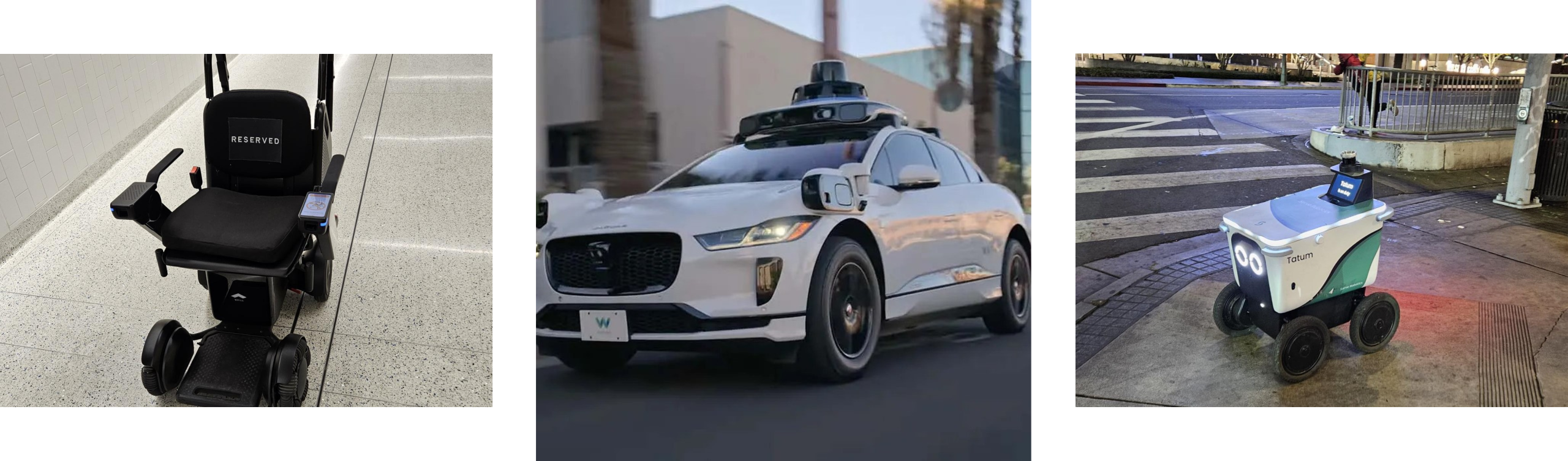
Last week I spent some time in Los Angeles, which shares a state with Silicon Valley, arguably the technology capital of the world. Within 24 hours after I arrived I saw all three of the above images, which one does not see in most cities in the United States but undoubtedly will soon. One of the images is of a Waymo self-driving taxi. I had seen these on TV but had never seen one in person and didn’t realize they had spread south of the Bay Area. From Waymo’s website I have since learned that its cabs now operate in six metropolitan areas in the United States, with eleven more on the horizon. Another image is of a robot delivering food in downtown Los Angeles. I had seen such robots on college campuses. However, this was the first time I saw one in a densely populated urban area. The final picture I took at LAX. It’s a self-driving wheelchair for passengers who need assistance moving from security checkpoints to departure gates. It appeared to be returning from a drop-off. A recorded voice told me to move out of the way when I stepped in front of it to take the picture.
Today, we rely on machines to perform less important tasks without much human backstop, and to assist humans more actively involved in performing more important tasks. No one thinks twice about using a laptop computer or smartphone to order a pizza on the internet. (When was the last time you called a phone number and spoke to a human being to order a pizza?) For some, it is already routine for the pizza to be delivered by a robot. If you’re willing to rely on a robot to deliver a pizza, would you trust a Waymo taxi to drive you home? Some do. I was less trusting in L.A. I used my smartphone order Uber rides but relied on humans to do the actual driving. What about flying from one city to another on a plane? Airlines have used autopilot functions for years, but I have yet to board a flight in which there aren’t at least two human beings in the cockpit, each of whom I presume knows how to fly the plane without autopilot assistance. The more important the task, the more hands-on human involvement we expect.
This brings me to the subject of artificial intelligence (AI) in the practice of law. I have been studying up on this subject over the past several months, and have begun using AI in my own practice. However, I am doing this carefully. My limited experience using AI confirms what I have read in the media and heard from attorneys who lecture on the subject: AI is a valuable tool, but it makes mistakes. I have heard legal AI platforms analogized to bright legal interns still in school. They have tremendous abilities and can offer valuable assistance. However, they require careful instruction and close supervision, and their work product usually needs to be revised. AI legal resources are expected to continue improving. Also in L.A. last week, I heard an attorney predict that AI will soon replace first-through-third-year associates at law firms. This makes me wonder how lawyers trained in this environment will develop analytical skills required to sufficiently review work product produced by AI. The legal profession will need to address this.
In the meantime, it is my impression that for some tasks, with thorough prompting on the front-end and careful review and editing of its work product on the back-end, AI can save lawyers time and clients money. The more important the task, the more hands-on human lawyering will be required.
Maybe I will take a Waymo taxi someday. However, I can promise you that if I ever live to see pilotless airplanes, I will never board one.